
Thursday, March 14, 2013
Robert Service on the Estonian KGB Records
This collection contains digitized copies of thousands of pages of Estonian KGB files relating to secret police and intelligence activities, dissident and anti-Soviet activities, and repatriation and nationalism issues in Estonia.
For more information on the Estonian KGB records in the Hoover Institution Archives, please visit:
www.hoover.org/library-and-archives/collections/east-europe/featured-collections/estonian-kgb
For more information about Dr. Robert Service, please visit: www.hoover.org/fellows/10470
Books by Robert Service


Thursday, November 29, 2012
Unlocking Andrzej Pomian's London Archive

Last month I had the privilege of participating in a conference titled "Documents of the Polish Underground State 1939–1945" organized by the Central Archives of Modern Records in Warsaw. My presentation was on the Andrzej Pomian papers, which I organized and which were recently added to the Hoover Archives. The conference was held in the historic PAST building which was captured in a fierce battle by the Home Army during the Warsaw Uprising in 1944. I was somewhat nervous about giving my talk; it was in Polish and I'd never spoken before an audience such as this. As usual, my worries were unfounded and my presentation was well received. I met a number of interesting historians and archivists, nearly thirty of whom also spoke during the two-day conference. Below is the translation of my presentation. Let me know what you think in the comments below.
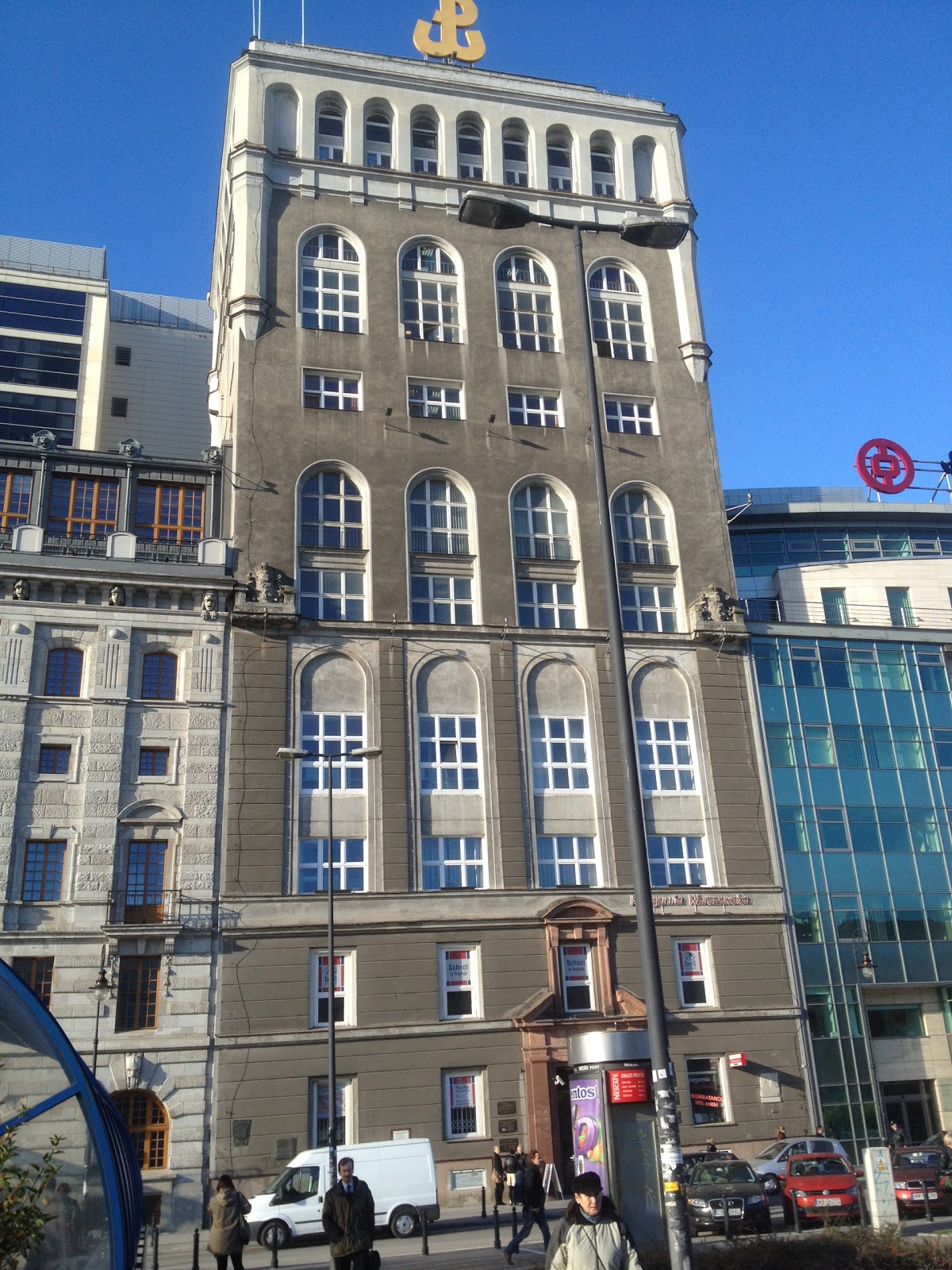
The PAST building (site of the conference) in downtown Warsaw
Andrzej Pomian, who died four years ago in Washington, DC, at the age of ninety-seven, was a Polish journalist and author who spent many years working for Radio Free Europe. During World War II, he was a member of the Bureau of Information and Propaganda of the Home Army the largest underground organization in Nazi-occupied Europe. Evacuated from Poland in April 1944 in one of the most spectacular flight operations of the war, Pomian worked in the Polish government in exile in London for the next ten years. He then moved to the United States, bringing with him a large metal trunk filled with notes, documents, underground publications, and reports on the Home Army’s activities. Those documents, untouched for more than fifty years in accordance with Pomian's wishes, were sent to the Hoover Institution Archives as a large addition to a small set of Pomian's papers donated earlier.
Andrzej Pomian (the name he adopted during the war) was born in 1911 as Bohdan Sałaciński in the Polish village of Black Ostrów in Podolia, which became part of the Soviet Union after 1920. Escaping from the Soviets, the family moved to Warsaw, where Bohdan became a student, completing his legal studies at the University of Warsaw in 1932, where he remained as a lecturer. From the beginning of the German occupation, Pomian was involved in underground work. He taught law at the underground university and worked in various units of the resistance, ending up at the Bureau of Information and Propaganda, which coordinated the work of intelligence and underground newspapers, broadcast underground radio programs, and operated photographic and film units.
Operation N, an initiative of the bureau, published documents in German aimed at weakening the morale of German soldiers and colonists in Poland. Several of the magazines and proclamations created under Operation N are in Pomian's collection. The Home Army was involved in sabotage, self-defense, and retaliation against the Germans. It also provided the Allies with crucial information in the field of intelligence, monitoring the movement of troops in the east and the development of the secret German V-1 and V-2 rockets. The primary goal of the Home Army, however, was to prepare for the expected collapse of the Nazi occupation and the liberation of the country.
After the Allied landing in Italy and the encroachment of the Red Army into prewar Polish territory, a national uprising was planned, to be centered in Warsaw, for the second half of 1944. In connection with this plan, the Home Army and the underground civil authorities ordered several officers, including Pomian, to report to the Polish and British authorities in London to discuss the preparations’ progress. These contacts were usually carried out by encrypted radio transmissions or by individual couriers and emissaries, but this important mission required a different method.
At that time regular night flights from England and southern Italy, with parachute drops of weapons, documents, money, and agents, were made into occupied Poland. A new joint Polish-British operation, Wildhorn I (Operation Most [Bridge] I in Polish), intended to land a plane in occupied Poland, was carried out in the evening of April 15, 1944. A Douglas Dakota aircraft, unarmed but equipped with eight additional fuel tanks, left its base near Brindisi in southern Italy. Crossing the Balkans and the Carpathian mountains en route to Poland, it landed, under difficult conditions, in a beet field near Lublin, southeast of Warsaw. The so-called runway was marked by bonfires and protected by several forest units of the Home Army. Couriers and bags of dollars were unloaded, and Pomian and other passengers, including Brigadier General Stanisław Tatar came on board, barely avoiding an intense and bloody firefight between soldiers of the Home Army and Wehrmacht units. The return flight to Brindisi and then Gibraltar brought Pomian to England twenty-four hours later.

The PAST building during the Warsaw Uprising, August, 1944
Pomian followed the tragic epilogue of the war in Poland from distant London. The Warsaw Uprising, lasting sixty-three days, failed due to lack of support from the Soviet Union—the Red Army that came a few weeks after the uprising began stopped on the Vistula River, just across from burning Warsaw. Poland's allies, the British and the Americans, could not do much to help but didn't even protest the Soviets’ treacherous behavior. Among the tens of thousands killed were most of Pomian's colleagues and friends. Warsaw was virtually razed to the ground, and Poland became a Soviet dependency. Western powers not only failed to protest but, in the following year, withdrew recognition of their loyal wartime ally. The uprising, not surprisingly, dominated Pomian's thoughts; the majority of his collection consists of documents related to that tragic event (including typescripts, manuscripts, poetry, newspapers, and government documents).
During his ten years in London, Pomian continued working for the Polish government in exile, coordinating contacts and financial support for the anticommunist underground in the country and veterans of the Home Army. When, in 1955, he decided to move to the United States, he packed everything into a big trunk, apparently never opening it again. Shortly before his death, he decided to pass it on to the archives of the Hoover Institution at Stanford University in California.
The Andrzej Pomian papers consist of twenty-two archival boxes. A significant portion of those materials are postwar newspaper clippings, newspapers, and magazines, often commemorating consecutive anniversaries of the Warsaw Uprising. Documents concerning the activities of the Bureau of Information and Propaganda and underground resistance are in the first six boxes.
This collection is now available to researchers. We plan to microfilm this collection and pass it on to the Central Archives of Modern Records, as we recently did with the microfilmed collection of Jan Karski.
I also wanted to share some scans from this collection. Here are examples of propaganda from Operation N. This cover suggests that it is an anti-Soviet brochure, but the text is devoted to the Nazi crimes in Poland. Several items from this collection, including this brochure, are showcased in an exhibition of World War II propaganda currently on display at the Hoover Institution.

"The Red Terror", Andrzej Pomian Papers, Hoover Institution Archives

Andrzej Pomian's later work is also well documented in the collection of the Polish station of Radio Free Europe The corporate and broadcast records of RFE/RL are housed at the Hoover Institution. Most of our collections on World War II were microfilmed, transferred to Poland, digitized, and made available online. The best guide to our Polish collections is the book by Professor (and Poland's director of the National Archives) Władyslaw Stępniak, Polish Archival Materials in the Collections of Hoover Institution at Stanford University.
Thank you very much.
Warsaw, Poland October 24, 2012
__________________________________
Nicholas Siekierski, an assistant archivist, is the exhibits and outreach coordinator at the Hoover Institution Library and Archives
Monday, October 15, 2012
What’s in a File Name?

Digital creators could take a page from expectant parents who carefully weigh names for their babies. File names can convey a great deal of meaning and are often the only clue to the contents of a digital file. A few collections of photographs at the Hoover Institution Archives show both missed opportunities and powerful names.
Douglas Smith, an American historian, was in Moscow during the attempted coup in August 1991. He took some photographs, which are part of the Douglas Smith miscellaneous papers, but their equipment-generated file names provide no information. Here’s an example:
DIA_0144.jpg
We know the photos depict the attempted coup because he told us, but a viewer must be familiar with both the place and the events to identify the content of each image. I’m reminded of the decades-old photos in a box in my mom’s closet; we assume they depict various ancestors but, because they don’t have captions, the people remain unnamed and unknown.
Giles Udy gave some thought to the file names for his photographs, which depict structures in the former gulag camps of Noril’sk in Russia. Some names are of the machine-generated variety, but he renamed others, as follows:
Admin block - ext (cell window far right) DSCN7527.pdf
This file name functions like a caption describing the image. Udy also retained the original file name, DSCN7527, which was smart because it connects the PDF version of the image that he gave to Hoover to the original image in its native format, which Udy chose to retain. Udy also arranged his photographs into digital folders so that all the images of the Alevrolitnaya penal camp are in one folder bearing the name of the camp.
John Bruning, who took thousands of photographs while embedded with a National Guard unit posted to Afghanistan in 2010, built on this descriptive naming by adding dates to many folder names in MMDDYY format:
Mission 02 090710 swing set
In addition, Bruning wrote accounts of the events that he photographed. This Mission 02 folder contains a Word document that describes the mission, which was intended to “pick up some U.S. Army engineers and a swing set. We would then air assault them into a landing zone next to Manny’s Bazaar so they could install the swing set at the local school.” Bruning’s story wraps his images in context and color.
But Bruning and Udy both failed in some technical aspects of file naming. First, they included many deprecated characters, such as spaces, parentheses, and other punctuation marks. In addition, some lengthy folder and file names exceeded the directory path limitations of our software system, causing the file names to be automatically truncated. For example, when copied, the file name
Unfinished building - piles in permafrost then bldg above 3558.JPG
became
UNFINI~1.JPG
All these small problems take time to locate and correct. Somewhat like expectant godparents, we’re still waiting for our first born-digital collection to arrive with perfect file names.
Friday, September 7, 2012
Data Recovery: To Delete or Not?

By applying technology to works of art, historians are discovering previously unknown masterpieces. Beneath a Goya painting is a work that the artist painted over for political reasons. Van Gogh’s Patch of Grass hides an underlying masterpiece. Because so many artists painted over their canvases so as to reuse them, more discoveries will come. Turning to the world of manuscripts, digital imaging tools can reveal written-over text or words obliterated by stains. When the focus is the oeuvre of the Old Masters or the authors of the Dead Sea Scrolls, who would object? But what if the focus is modern writings--maybe even yours?
With born-digital materials, archivists have the opportunity to resurrect digital files deleted by their creators. One such route involves forensic tools and techniques, similar to those used by police, including analyzing computers that may hold evidence of criminal activity. Such forensic software is gaining currency among archivists. There’s an entire report called Digital Forensics and Born-Digital Content in Cultural Heritage Collections, and our colleagues at Stanford University Libraries use a Forensic Recovery of Evidence Devices (FRED) setup to process incoming digital collections.
Hoover’s processing workflow for born-digital materials closely follows the steps outlined by OCLC Research in its latest publication; indeed, Hoover was one of the models for it. We omit the forensic software layer for a leaner workflow that maximizes resources. But even without forensic technology, while processing the Jude Wanniski papers, we found ourselves in the position of those art historians: Should we recover the e-mail messages we found in Wanniski’s digital trash bin? If Wanniski deleted them--much like an artist who paints over his own work--is it appropriate for us to preserve and reveal them to researchers?
Thursday, August 30, 2012
The Rescuer and the Rescued: A Latvian Story of the Holocaust
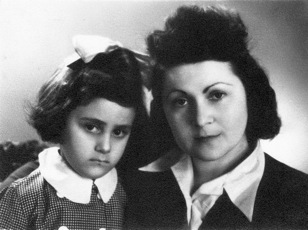 |
Riva Zivcon and her daughter Adinka
(photo courtesy of Ada Zivcon Israeli)
|
Edward Anders, a retired astrophysicist living in Burlingame, California, is sponsoring research into a story that is informed by his own life and the circumstances under which he survived the Holocaust in his native Latvia.
As a Jewish teenager living in the port city of Liepāja, Anders and his family were in extreme peril when the Nazis invaded Soviet-occupied Latvia in 1941. Other members of Anders’s family perished in the Holocaust, but he and his mother survived. This was initially due to the young Anders falsely claiming to the new authorities that his mother was really a German foundling raised by a Latvian Jewish couple. Two Latvian women vouched for this claim, at great risk to themselves.
After World War II, and time spent as a refugee in Germany, Anders came to the United States, where he became a noted scientist specializing in the study of meteorites. Since retiring from the University of Chicago, he has been active as an historian, with an emphasis on documenting the fate of Latvian Jews during the war. As part of this effort, he created a searchable database of about 7000 Jewish persons alive in Liepāja in June 1941, with information describing what happened to them subsequently. In October 2000, he took part in the first conference in post-Soviet Latvia on the Holocaust, and he has made important contributions to the work of the Museum of the Occupation of Latvia, located in Rīga.
In addition to publishing two volumes of memoirs (a full autobiography From Darkness to Light in 2008 and a condensed 2010 version Amidst Latvians during the Holocaust), Anders arranged for the translation and publication of the diary of another Latvian Holocaust survivor, Kalman Linkimer. In his diary, Linkimer not only wrote about his own experiences in wartime Latvia but also transcribed the accounts of other Latvian Jews hiding from the Nazis. In one of these transcriptions, Riva Zivcon describes how a Latvian policeman, a certain Corporal Avots, helped her and her 3-year-old daughter Adinka escape from the Rīga ghetto. Accompanied by Riva Zivcon and carrying Adinka on his arm, the policeman walked out one of the ghetto gates, brazenly telling the guards he encountered that the mother and daughter were his own wife and child.
 |
Former site of one of the Rīga ghetto gates.
Holokausta izpētes problēmas Latvijā collection, Box 1, Hoover Institution Archives
|
Avots then took the Zivcons to the home of his girlfriend, telling her that the two were Russians. But when the girlfriend discovered that Adinka spoke only Yiddish, she became fearful of hiding the Zivcons in her place. Avots then took the Zivcons to the home of a prewar acquaintance, a violinist with whom the pair stayed for several weeks before returning to Liepāja, where separate hiding places were found for mother and daughter. Both Zivcons survived the war.
 |
Adinka Zivcon (photo courtesy of Ada Zivcon Israeli)
|
However, in the case of Corporal Avots, the question of having recognition bestowed was complicated by the fact that Riva Zivcon did not learn the first name of the policeman who rescued her and her baby, and in the Linkimer diary he is referred to only by his surname. The ghetto guard of which Avots was part consisted of members of the 20th Latvian police battalion and selected members of the Rīga municipal police. No central roster of the ghetto guard has ever been discovered, but the most promising source for information on these police units are records contained in the Latviešu Centrālā Komiteja collection in the Hoover Institution Archives.
So far, Meldra Atteka and Una Veilande (Latvian researchers who have volunteered to work for Professor Anders) have found references in this collection to more than one Corporal Avots. Their latest find, which refers to a Corporal Fricis Avots, seems to be the most promising lead, and Professor Anders is optimistic that a solution is at hand to the nearly 75-year-old mystery of the exact identity of the Riga policeman who rescued the Zivcons. The researchers still have about 10 manuscript boxes of documents to go through, and they will continue to look for more documentation relating to the puzzle. Copies of the documents, should they turn out to be ones identifying the right Corporal Avots, will then be submitted to Yad Vashem. If Yad Vashem decides to recognize Avots as a rescuer of Jews, the Latvian government would honor him as well. A plaque at the entrance of a street where the Rīga ghetto was once located honors another “righteous gentile,” Zhan Lipke.
 |
Plaque in Rīga honoring Zhan Lipke.
Holokausta izpētes problēmas Latvijā collection, Box 1, Hoover Institution Archives
|
The Latviešu Centrālā Komiteja collection is the single largest resource on Latvian history in the Hoover Institution Archives. It is very much a composite: a large part of the collection pertains to the life of Latvians in Displaced Persons’ Camps in Germany after World War II; another significant component consists of records relating to Latvian police and military units that were created under the German occupation of Latvia during World War II. The collection also contains demographic data about Latvia under the German occupation, materials relating to nationalist resistance groups in Latvia during the same period, and issuances of the government of independent Latvia before the country’s annexation by the Soviet Union in 1940.
The complexity of the situation in Latvia during World War II, and the dual tragedies of Latvian Jews in peril from the Nazis and other Latvians at risk of imprisonment and deportation by Soviet authorities, is captured in a recent documentary film entitled Controversial History (directed by Inara Kolmane and Uldis Neiburgs, Rīga, 2010). Edward Anders figures prominently in this film as one of three individuals who recount their experiences in Latvia during World War II. In the film, Anders revisits Liepāja and the site near that town where the Nazis murdered some 2739 Jews on December 15, 1941. The documentary is in the audiovisual collection of Green Library at Stanford University.
Related archival collection:
Holokausta izpētes problēmas Latvijā (Conference: 2000: Riga, Latvia)
Tuesday, August 14, 2012
Herbert Hoover's Grand Parade in Warsaw
 |
| Children from General School No. 11, many of them barefoot, prepare for the parade in honor of Herbert Hoover, August 14, 1919. “American Friendship: Herbert Hoover and Poland” Exhibit Catalog |
Hoover took a particular interest in Poland when he learned of the serious shortages of food in the country and its effect on children. At Hoover’s initiative, shipments of condensed milk, flour, and wheat, totaling thousands of tons, began arriving in Poland in the spring of 1919. By the time of his visit in August, an extensive operation had been established through the cooperation of the A.R.A. and civic organizations, which established hundreds of kitchens that fed more than 500,000 children daily. Within a year the operation would feed as many as 1.5 million children and nursing mothers each day. The humanitarian aid for children was a precursor to massive shipments of clothing, shoes and medical supplies to establish inoculation centers against typhus and other diseases. Extensive technical assistance from American advisers also helped rebuild Poland’s railways and other industries. The Poles had much to be grateful for.
Vernon Kellogg, a close associate of Hoover’s who made the initial reports on the situation in Poland, was present in Warsaw at the Mokotow Field on August 14:
It was a great day for the children of Warsaw. It was a great day for their parents, too, and for all the people and for the Polish Government. But it was especially the great day of the children. The man whose name they all knew as well as their own, but whose face they had never seen, and whose voice they had never heard, had come to Warsaw. And they were all to see him and he was to see them.
He had not announced his coming, which was a strange and upsetting thing for the government and city officials whose business it is to arrange all the grand receptions and the brilliant parades for visiting guests to whom the Government and all the people wish to do honor. And there was no man in the world to whom the Poles could wish to do more honor than to this uncrowned simple American citizen whose name was for them the synonym of savior.
 |
| A group of children in Eastern Poland forming the letter “H” in honor of Herbert Hoover, 1921. “American Friendship: Herbert Hoover and Poland” Exhibit Catalog |
So it was no wonder that the high officials of the Polish Government and capital city were in a state of great excitement when the news suddenly came that the man whom they had so often urged to come to Poland was really moving swiftly from Prague to Warsaw.
Ever since soon after Armistice Day he had sat in Paris, directing with unremitting effort and absolute devotion the task of getting food to the mouths of hungry people of all the newly liberated but helpless countries of Eastern Europe, and above all, to the children of these countries, so that the coming generation, on whom the future of these struggling peoples depended, should be kept alive and strong. And now he was preparing to return to his own country and his own children to take up again the course of his life as a simple American citizen at home.
But before going he wanted to see for himself, if only by the most fleeting of glimpses, that the people of Poland and Bohemia and Serbia and all the rest were really being fed. And especially did he want to see that the children were alive and strong.
When he came to Paris in November, 1918, at the request of the President of the United States to organize the relief of the newly liberated peoples of Eastern Europe, terrible tales were brought to him of the suffering and the wholesale deaths of the children of these ravaged lands. And when those of us who went to Poland for him in January, 1919, to find out the exact conditions and the actual food needs of the twenty-five million freed people there, made our report to him, a single unpremeditated sentence in this report seemed most to catch his eyes and hold his attention. It did more; it wetted his eyes and led to a special concentration of his efforts on behalf of the suffering children. This sentence was: “We see very few children playing in the streets of Warsaw.” Why were they not playing? The answer was simple and sufficient: The children of Warsaw were not strong enough to play in the streets. They could not run; many could not walk; some could not even stand. Their weak little bodies were bones clothed with skin, but not muscles. They simply could not play.
So in all the excitement of the few hours possible to the citizens of Warsaw and the Government Officials of Poland to make hurried preparation to honor their guest and show him their gratitude, one thing they decided to do, which was the best thing for the happiness of their guest they could possibly have done. They decided to show him that the children of Warsaw could now walk!
So seventy thousand boys and girls were summoned hastily from the schools. They came with the very tin cups and pannikins from which they had just had their special meal of the day, served at noon in all the schools and special children’s canteens, thanks to the charity of America, as organized and directed by Hoover, and they carried their little paper napkins, stamped with the flag of the United States, which they could wave over their heads. And on an old race-track of Warsaw, these thousands of restored children marched from mid-afternoon till dark in happy, never-ending files past the grandstand where sat the man who had saved them, surrounded by the heads of Government and the notables of Warsaw.
 |
Herbert Hoover (no. 6) sits next to Prime Minister IgnacyPaderewski (no. 5), Commander-in-Chief Josef Piłsudski (no. 9), Ambassador HughGibson (no. 11) and Commander George Barr Baker (no. 4), in front of Belvedere Palace in Warsaw, August, 1919. “American Friendship: Herbert Hoover andPoland” Exhibit Catalog
|
(“Review of the Children of Warsaw”, Vernon Kellogg papers, Box 1, Folder 1, Hoover Institution Archives)
Wednesday, August 8, 2012
Tower of Peace
 |
| Mary Wright, curator of the Chinese collection and C. Easton Rothwell, director of the Hoover Institution, examine a shipment of documents, with collection assistant Eugene Wu in the foreground, 1950s. Hoover Institution Records, Hoover Institution Archives |
One of the more pleasing features of the Hoover Tower is our excellent carillon. Last month, I made a recording of it as part of the Free to Choose Network’s tribute to Milton Friedman. If you’ve ever been on campus in the early evening, perhaps you’ve heard the chimes. If not, I suggest clicking that link.
Writing to the audiophiles, recordists, audiophile recordists, and other sound enthusiasts out there, it was really a great experience. I was shocked to learn how relatively quiet these bells are. Posts at a recording forum had me believe they could get as loud as a jet engine. Ours only gets up to around 115 dB! I had planned an elaborate rig where a handful of mics would stick out of windows on the 11th floor, but, no, I could mic the carillon right up in there on the platform (wearing ear plugs, of course) with just a simple X-Y pair. Moreover, the normally blusterous wind decided to stay away while I had microphones up that high, and I was able to get a surprisingly good representation.
For more information about the carillon, please see I Ring Only for Peace by Elena Danielson.
Speaking of the tower, back in 1957, the Hoover Institution produced a radio series entitled Tower of Peace. In it, a host interviewed several notable people from the Hoover and larger Stanford communities to highlight the collections of the Institution and the work done by those studying them. No surprise, lots of important research and many saw the collections as some of the best in the world, whether they be of European, African, Middle Eastern, or East Asian focus. What did surprise me, however, given that this dates from 1957, is how many women were featured, and how prominent of a role they played here at Hoover.
Who were these women? Ruth Perry, curator of the African collection; Mary Wright, curator of the Chinese collection; Agnes Peterson, area associate for Central and Western European collections; Christina Harris, curator of the Middle Eastern collection; Inez Richardson, coordinator for foreign visitors to Stanford University; and Hildegard Behringer, program officer in Stanford's office for foreign visitors.
Finally, working on this collection was not without irony, either. In the introductory program, Herbert Hoover himself spoke of the need to migrate the content of newspapers to microfilm before they deteriorated. I heard him say this from a structurally-deficient acetate tape being digitized before it becomes unplayable itself.
Subscribe to:
Posts (Atom)