Showing posts with label Poland. Show all posts

Tuesday, May 7, 2013

Digitizing Mieczysław Jałowiecki's Illustrations


Church of the Ascension, Wilno (Vilnius) 

The Hoover Institution Library and Archives is home to art with enduring historic value that is both diverse in content and style. One such collection, the illustrations of Mieczyslaw Jałowiecki, were recently photographed by the Digital Imaging Lab so we could provide digital copies to our partner institutions in Lithuania and Poland and eliminate handling the originals during on-site research. Unlike other collections of art at  Hoover, scenes of war, revolution, and destruction are absent in these illustrations. Rather, Jałowiecki depicts his culture, his history, his motherland--before it was nearly obliterated by war and totalitarianism.

Jałowiecki (1886–1962) had numerous occupations through his long life: landowning noble, agronomist, civil servant, diplomat, businessman, writer, and artist, to a name a few. Yet his versatility did not spare him from the social, economic, and political upheaval of his times. Jałowiecki was twice forced to abandon his land and country, once in Lithuania following World War I, and again with the Soviet/German invasion of Poland in 1939.  Despite the vicissitudes of revolution and war, Jałowiecki applied his knowledge and experience to serve his people, history, and culture. He ensured that food from the American Relief Administration passed unimpeded through the port of Gdańsk during 1919–1920; later in his life he was an activist for the Polish government in exile, a publisher of pamphlets and books about agronomy and Poland, and the author of a sixteen-volume memoir.

In all, Jałowiecki created over a thousand illustrations, each with an accompanying title and, often, a geographic and historic summary of the topic.  Using watercolor and pencil as his mediums, Jałowiecki depicted manors, farms, and cities he saw during his extensive travels throughout western Russia, the Baltic region, and Poland. He also relied on photograph collections of fellow émigrés in England, along with resources from the British Museum, to create visions of sacred icons and shrines, medieval rulers, pivotal battles, archeological sites, and the flora and fauna of the region.

Producing the digital images from the materials could not be done with a flat bed scanner, for it requires an unacceptable amount of contact with the illustrations; we thus made each photograph with our medium-format digital camera. In consultation with the Book and Paper Preservation Lab, a workflow was designed to minimize handling and to quickly capture each illustration in sequential order.  In planning the workflow, however, it became apparent that each illustration would need to be interleaved at some point to improve their state of preservation.  This procedure, a considerable undertaking, became one of timing: Should interleaving occur before, after, or during the photography phase? The answer is a salient example of why planning a digitization project cannot be arbitrarily reduced to its most basic elements of scanning a document or snapping a photograph. A process that appears simple can actually be complex or a component of a larger and more intricate process. For our purposes, when planning a digitization project, the decisions we make--be they standards, methods, or the order in which they are implemented--are treated as though each will reverberate across the entire project.


A critical decision was to have the illustrations interleaved after the photography phase. Interleaving the illustrations with acid-free nonabrasive paper is critical to their long- term survival. But interleaving requires a great deal of time, as each illustration must be individually enclosed in a leaf of paper. The additional bulk of that paper would require the entire collection be redistributed among their folders and boxes to prevent overfilling, another important component of long-term preservation. Because the location of each illustration is described in the finding aid, that redistribution would also require that the finding aid be revised, another critical but time-intensive task. Finally, handling each illustration after interleaving requires each to be removed from its individual leaf and then returned after being photographed, thus incurring more time and cost on the project. All these factors led us to conclude that interleaving after the photography phase was the most efficient use of project resources.

Another example of the complexity entailed in planning a digitization project arose when it came to creating filing names of digital images to correspond with the original filing names created by Jałowiecki. Variants and errors are not uncommon in large collections. As a collection grows, the probability of a variant or error occurring grows as well. We encountered duplicate catalog numbers that described entirely different images. We also encountered descriptions of an illustration on the reverse that did not match the image on the front and unused catalog numbers that created errors in the sequential numbering of each digital image. Finding a mislabeled file is not only difficult, the error of each mislabeled file will also cascade over the files that follow it when named en masse, creating new errors and compounding the problem.

Multiple steps were required to eliminate variants and errors in the filing names.  First, we separated out those files with duplicate catalog numbers and put one group in a separate folder. Free of duplicates, we then separated the remaining files into two groups: front and back. In this way, both groups could be renamed separately, thus preventing the back of each watercolor being renamed as though it were the following illustration. Second, we created targets for each catalog number without an associated image so they could be inserted in each group. These targets prevented our program from naming an illustration with the “empty” catalog number that preceded it. With these steps in place, both groups were quickly processed. After renaming, every file with a duplicated catalog number was given a suffix to distinguish each from its counterpart.

Creating and arranging the digital component of the Jałowiecki illustrations was both a privilege and a challenge. But paramount to the Digital Imaging Lab was the legacy we would impart. The decisions we made would not only reverberate across the span of the project but across the Atlantic Ocean and, possibly, across generations of students and researchers in Lithuania and Poland. The Jałowiecki illustrations will continue to inform research here at the Hoover Institution, but now they will also enrich historical research and cultural memory in Lithuania and Poland.


Thursday, November 29, 2012

Unlocking Andrzej Pomian's London Archive


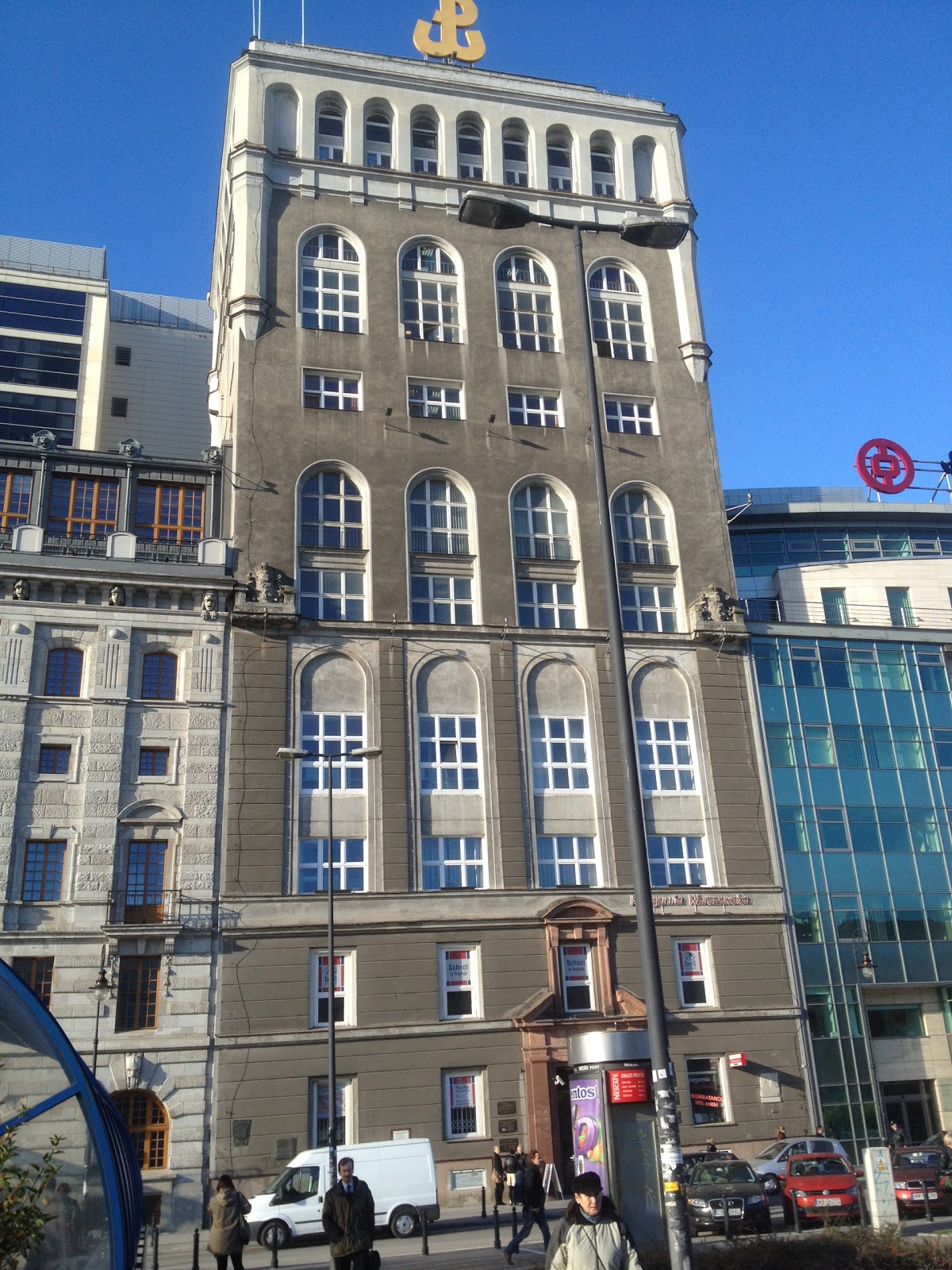
Last month I had the privilege of participating in a conference titled "Documents of the Polish Underground State 1939–1945" organized by the Central Archives of Modern Records in Warsaw. My presentation was on the Andrzej Pomian papers, which I organized and which were recently added to the Hoover Archives. The conference was held in the historic PAST building  which was captured in a fierce battle by the Home Army during the Warsaw Uprising in 1944. I was somewhat nervous about giving my talk;  it was in Polish and I'd never spoken before an audience such as this. As usual, my worries were unfounded and my presentation was well received. I met a number of interesting historians and archivists, nearly thirty of whom also spoke during the two-day conference. Below is the translation of my presentation. Let me know what you think in the comments below.


The PAST building (site of the conference) in downtown Warsaw

Andrzej Pomian, who died four years ago in Washington, DC, at the age of ninety-seven, was a Polish journalist and author who spent many years working for Radio Free Europe. During World War II, he was a member of the Bureau of Information and Propaganda of the Home Army  the largest underground organization in Nazi-occupied Europe. Evacuated from Poland in April 1944 in one of the most spectacular flight operations of the war, Pomian worked in the Polish government in exile in London for the next ten years. He then moved to the United States, bringing with him a large metal trunk filled with notes, documents, underground publications, and reports on the Home Army’s activities. Those documents, untouched for more than fifty years in accordance with Pomian's wishes, were sent to the Hoover Institution Archives as a large addition to a small set of Pomian's papers donated earlier.

Andrzej Pomian (the name he adopted during the war) was born in 1911 as Bohdan Sałaciński in the Polish village of Black Ostrów in Podolia, which became part of the Soviet Union after 1920. Escaping from the Soviets, the family moved to Warsaw, where Bohdan became a student, completing his legal studies at the University of Warsaw in 1932, where he remained as a lecturer. From the beginning of the German occupation, Pomian was involved in underground work. He taught law at the underground university and worked in various units of the resistance, ending up at  the Bureau of Information and Propaganda, which coordinated the work of intelligence and underground newspapers, broadcast underground radio programs, and operated photographic and film units.

Operation N, an initiative of the bureau, published documents in German aimed at weakening the morale of German soldiers and colonists in Poland. Several of the magazines and proclamations created under Operation N are in Pomian's collection. The Home Army was involved in sabotage, self-defense, and retaliation against the Germans. It also provided the Allies with crucial information in the field of intelligence, monitoring the movement of troops in the east and the development of the secret German V-1 and V-2 rockets. The primary goal of the Home Army, however, was to prepare for the expected collapse of the Nazi occupation and the liberation of the country.

After the Allied landing in Italy and the encroachment of the Red Army into prewar Polish territory, a national uprising was planned, to be centered in Warsaw, for the second half of 1944. In connection with this plan, the Home Army and the underground civil authorities ordered several officers, including Pomian, to report to the Polish and British authorities in London to discuss the preparations’ progress. These contacts were usually carried out by encrypted radio transmissions or by individual couriers and emissaries, but this important mission required a different method.

At that time regular night flights from England and southern Italy, with parachute drops of weapons, documents, money, and agents, were made into occupied Poland. A new joint Polish-British operation, Wildhorn I (Operation Most [Bridge] I in Polish), intended to land a plane in occupied Poland, was carried out in the evening of April 15, 1944. A Douglas Dakota aircraft, unarmed but equipped with eight additional fuel tanks, left its base near Brindisi in southern Italy. Crossing the Balkans and the Carpathian mountains en route to Poland, it landed, under difficult conditions, in a beet field near Lublin, southeast of Warsaw. The so-called runway was marked by bonfires and protected by several forest units of the Home Army. Couriers and bags of dollars were unloaded, and Pomian and other passengers, including Brigadier General Stanisław Tatar came on board, barely avoiding an intense and bloody firefight between soldiers of the Home Army and Wehrmacht units. The return flight to Brindisi and then Gibraltar brought Pomian to England twenty-four hours later.


The PAST building during the Warsaw Uprising, August, 1944

Pomian followed the tragic epilogue of the war in Poland from distant London. The Warsaw Uprising, lasting sixty-three days, failed due to lack of support from the Soviet Union—the Red Army that came a few weeks after the uprising began stopped on the Vistula River, just across from burning Warsaw. Poland's allies, the British and the Americans, could not do much to help but didn't even protest the Soviets’ treacherous behavior. Among the tens of thousands killed were most of Pomian's colleagues and friends. Warsaw was virtually razed to the ground, and Poland became a Soviet dependency. Western powers not only failed to protest but, in the following year, withdrew recognition of their loyal wartime ally. The uprising, not surprisingly, dominated Pomian's thoughts; the majority of his collection consists of documents related to that tragic event (including typescripts, manuscripts, poetry, newspapers, and government documents).

During his ten years in London, Pomian continued working for the Polish government in exile, coordinating contacts and financial support for the anticommunist underground in the country and veterans of the Home Army. When, in 1955, he decided to move to the United States, he packed everything into a big trunk, apparently never opening it again. Shortly before his death, he decided to pass it on to the archives of the Hoover Institution at Stanford University in California.

The Andrzej Pomian papers consist of twenty-two archival boxes. A significant portion of those materials are postwar newspaper clippings, newspapers, and magazines, often commemorating consecutive anniversaries of the Warsaw Uprising. Documents concerning the activities of the Bureau of Information and Propaganda and underground resistance are in the first six boxes.

This collection is now available to researchers. We plan to microfilm this collection and pass it on to the Central Archives of Modern Records, as we recently did with the microfilmed collection of Jan Karski.

I also wanted to share some scans from this collection. Here are  examples of propaganda from Operation N. This cover suggests that it is an anti-Soviet brochure, but the text is devoted to the Nazi crimes in Poland. Several items from this collection, including this brochure, are showcased in an exhibition of World War II propaganda currently on display at the Hoover Institution.


"The Red Terror", Andrzej Pomian Papers, Hoover Institution Archives


Andrzej Pomian's later work is also well documented in the collection of the Polish station of Radio Free Europe  The corporate and broadcast records of RFE/RL are housed at the Hoover Institution. Most of our collections on World War II were microfilmed, transferred to Poland, digitized, and made available online. The best guide to our Polish collections is the book by Professor (and Poland's director of the National Archives) Władyslaw Stępniak, Polish Archival Materials in the Collections of Hoover Institution at Stanford University.

Thank you very much.

Warsaw, Poland October 24, 2012
__________________________________

Nicholas Siekierski, an assistant archivist, is the exhibits and outreach coordinator at the Hoover Institution Library and Archives

Tuesday, August 14, 2012

Herbert Hoover's Grand Parade in Warsaw

Children from General School No. 11, many of them barefoot, prepare for the parade in honor of Herbert Hoover, August 14, 1919. “American Friendship: Herbert Hoover and Poland” Exhibit Catalog
     Today marks the 93rd anniversary of Herbert Hoover’s historic visit to Warsaw, Poland. It wasn’t his first visit, nor his last, but surely the most memorable and one of the most moving experiences of his life. At that time Herbert Hoover was chairman of the American Relief Administration (A.R.A.), which had begun to provide massive humanitarian aid to Eastern Europe, then recovering from the devastation of World War I.
     Hoover took a particular interest in Poland when he learned of the serious shortages of food in the country and its effect on children. At Hoover’s initiative, shipments of condensed milk, flour, and wheat, totaling thousands of tons, began arriving in Poland in the spring of 1919. By the time of his visit in August, an extensive operation had been established through the cooperation of the A.R.A. and civic organizations, which established hundreds of kitchens that fed more than 500,000 children daily. Within a year the operation would feed as many as 1.5 million children and nursing mothers each day. The humanitarian aid for children was a precursor to massive shipments of clothing, shoes and medical supplies to establish inoculation centers against typhus and other diseases. Extensive technical assistance from American advisers also helped rebuild Poland’s railways and other industries. The Poles had much to be grateful for.

Vernon Kellogg, a close associate of Hoover’s who made the initial reports on the situation in Poland, was present in Warsaw at the Mokotow Field on August 14:

  It was a great day for the children of Warsaw. It was a great day for their parents, too, and for all the people and for the Polish Government. But it was especially the great day of the children. The man whose name they all knew as well as their own, but whose face they had never seen, and whose voice they had never heard, had come to Warsaw. And they were all to see him and he was to see them.
  He had not announced his coming, which was a strange and upsetting thing for the government and city officials whose business it is to arrange all the grand receptions and the brilliant parades for visiting guests to whom the Government and all the people wish to do honor. And there was no man in the world to whom the Poles could wish to do more honor than to this uncrowned simple American citizen whose name was for them the synonym of savior.

A group of children in Eastern Poland forming the letter “H” in honor of Herbert Hoover, 1921. “American Friendship: Herbert Hoover and Poland” Exhibit Catalog
  For what was their new freedom worth if they could not be alive to enjoy it? And their being alive was to them all so plainly due to the heart and brain and energy and achievement of this extraordinary American, who sat always somewhere far away in Paris, and pulled the strings that moved the diplomats and the money and the ships and the men who helped him manage the details, and converted all of the activities of these men and all of these things into food for Warsaw---and for all Poland. It was food that the people of Warsaw and all Poland simply had to have to keep alive, and it was food that they simply could not get for themselves. They all knew that. The name of another great American (Woodrow Wilson) spelled freedom for them; the name Herbert Hoover spelled life to them.
  So it was no wonder that the high officials of the Polish Government and capital city were in a state of great excitement when the news suddenly came that the man whom they had so often urged to come to Poland was really moving swiftly from Prague to Warsaw.
  Ever since soon after Armistice Day he had sat in Paris, directing with unremitting effort and absolute devotion the task of getting food to the mouths of hungry people of all the newly liberated but helpless countries of Eastern Europe, and above all, to the children of these countries, so that the coming generation, on whom the future of these struggling peoples depended, should be kept alive and strong. And now he was preparing to return to his own country and his own children to take up again the course of his life as a simple American citizen at home.
  But before going he wanted to see for himself, if only by the most fleeting of glimpses, that the people of Poland and Bohemia and Serbia and all the rest were really being fed. And especially did he want to see that the children were alive and strong.
  When he came to Paris in November, 1918, at the request of the President of the United States to organize the relief of the newly liberated peoples of Eastern Europe, terrible tales were brought to him of the suffering and the wholesale deaths of the children of these ravaged lands. And when those of us who went to Poland for him in January, 1919, to find out the exact conditions and the actual food needs of the twenty-five million freed people there, made our report to him, a single unpremeditated sentence in this report seemed most to catch his eyes and hold his attention. It did more; it wetted his eyes and led to a special concentration of his efforts on behalf of the suffering children. This sentence was: “We see very few children playing in the streets of Warsaw.” Why were they not playing? The answer was simple and sufficient: The children of Warsaw were not strong enough to play in the streets. They could not run; many could not walk; some could not even stand. Their weak little bodies were bones clothed with skin, but not muscles. They simply could not play.
  So in all the excitement of the few hours possible to the citizens of Warsaw and the Government Officials of Poland to make hurried preparation to honor their guest and show him their gratitude, one thing they decided to do, which was the best thing for the happiness of their guest they could possibly have done. They decided to show him that the children of Warsaw could now walk!
  So seventy thousand boys and girls were summoned hastily from the schools. They came with the very tin cups and pannikins from which they had just had their special meal of the day, served at noon in all the schools and special children’s canteens, thanks to the charity of America, as organized and directed by Hoover, and they carried their little paper napkins, stamped with the flag of the United States, which they could wave over their heads. And on an old race-track of Warsaw, these thousands of restored children marched from mid-afternoon till dark in happy, never-ending files past the grandstand where sat the man who had saved them, surrounded by the heads of Government and the notables of Warsaw.

Herbert Hoover (no. 6) sits next to Prime Minister IgnacyPaderewski (no. 5), Commander-in-Chief Josef Piłsudski (no. 9), Ambassador HughGibson (no. 11) and Commander George Barr Baker (no. 4), in front of Belvedere Palace in Warsaw, August, 1919. “American Friendship: Herbert Hoover andPoland” Exhibit Catalog
  They marched and marched and cheered and cheered, and waved their little hands and cups and napkins. And all went by as decorously and in as orderly a fashion as many thousands of happy cheering children could be expected to, until suddenly from the grass an astonished rabbit leaped out and started down the track. And then five thousands of these children broke from the ranks and dashed madly after him, shouting and laughing. And they caught him and brought him in triumph as a gift to their guest. But they were astonished to see as they gave him their gift, that this great strong man did just what you or I or any other human sort of human being could not have helped doing under like circumstances. They saw him cry. And they would not have understood, if he had tried to explain to them that he cried because they had proved to him that they could run and play. So he did not try. But the children of Warsaw had no need to be sorry for him. For he cried because he was glad.

(“Review of the Children of Warsaw”, Vernon Kellogg papers, Box 1, Folder 1, Hoover Institution Archives)